Visual Framework
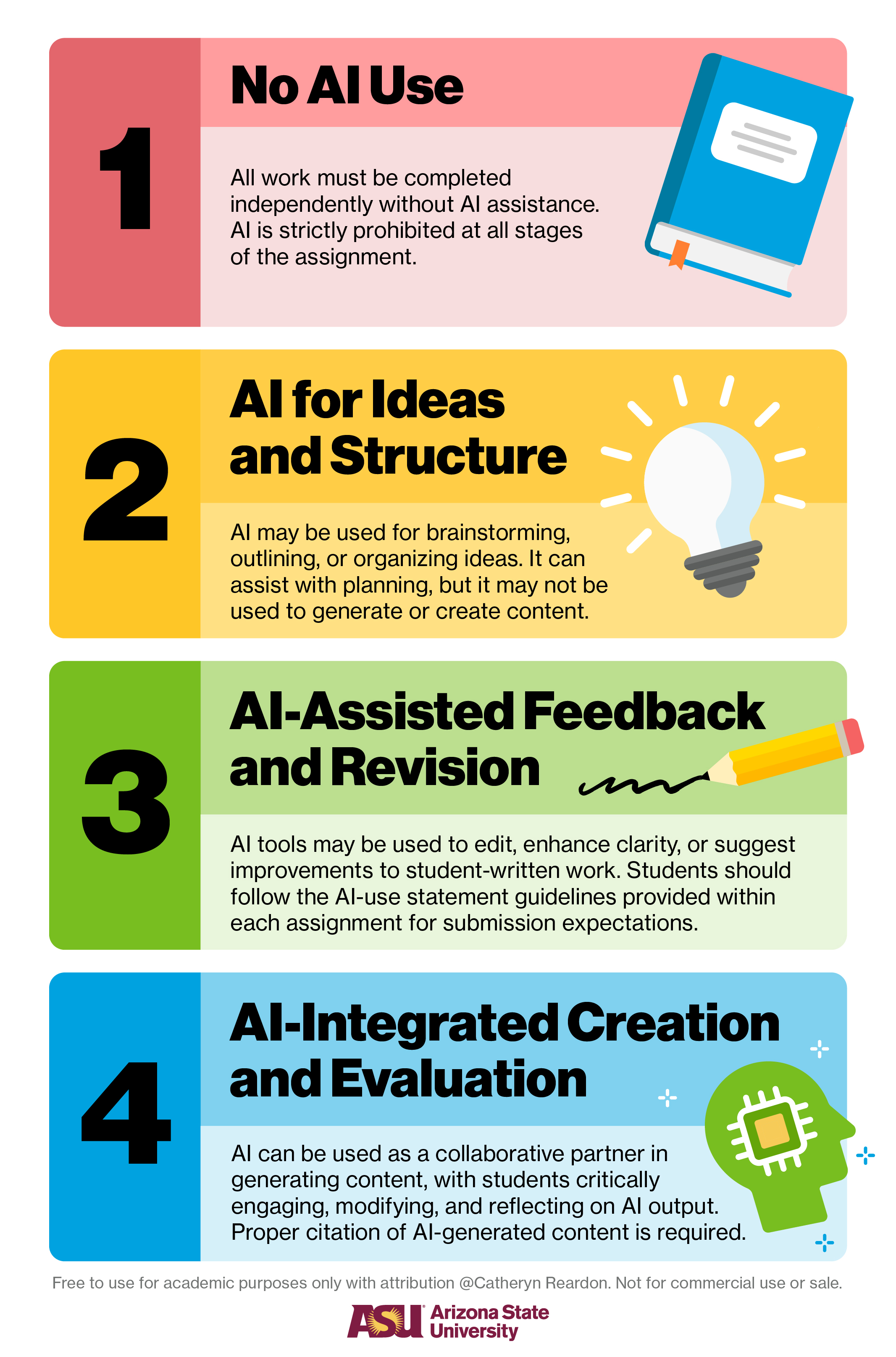
Visual framework for AI use levels in academic settings. © Catheryn Reardon
A Human-Centered Framework for Ethical and Reflective AI Use in Education
These AI use guidelines provide a structured, human-centered approach to integrating artificial intelligence into coursework. The goal is not to restrict AI use entirely, but to guide it in a way that preserves learning, supports critical thinking, and reinforces ethical responsibility.
Students are encouraged to use AI intentionally and transparently. The guidelines clarify expectations while also helping students reflect on how AI influences their thinking, decision-making, and academic work.
Students complete all work independently without the use of AI tools. This level is used when the goal is to assess foundational knowledge, individual reasoning, or original skill development.
AI may be used to generate ideas, outline responses, or organize thinking. Students are still responsible for developing, writing, and refining their own work.
AI may be used to provide feedback on drafts, suggest improvements, or help clarify ideas. Students remain responsible for evaluating the feedback and deciding how to revise their work.
AI can be used as a collaborative partner in generating content. Students must critically evaluate AI contributions, revise outputs, and clearly acknowledge how AI was used in the process.
Without clear expectations, students may either over-rely on AI or avoid using it altogether. These guidelines create a shared understanding of appropriate use, allowing students to engage with AI in ways that support learning rather than bypass it.
The framework also reinforces that students remain the authors and decision-makers in their work. AI can support learning, but it cannot replace critical thinking, judgment, or responsibility.
These guidelines are designed to work alongside the Human-Centered AI Metacognitive Learning Model (HAIML). While the guidelines define what types of AI use are appropriate, HAIML focuses on how students think about their use of AI.
Together, these frameworks support a learning environment where students actively engage with AI, reflect on how it shapes their thinking, and make ethical decisions about its use.
Reflection is a key part of human-centered AI use. These prompts help students move beyond simply reporting whether they used AI and toward thinking more deeply about how AI shaped their process.
I used AI to help brainstorm possible ways to organize my response and identify areas where my explanation could be clearer. I did not copy its language directly, but I used it to think through how I wanted to structure my ideas. One thing I noticed is that AI made it easier to get started, but I still had to decide what fit my argument and what did not. It helped me revise more efficiently, but it also reminded me that I need to stay actively involved in evaluating what makes sense.
The following language can be adapted for course syllabi, assignment instructions, or student-facing policy documents.
Artificial intelligence tools may be used in this course only when explicitly permitted. Acceptable use depends on the assignment and may range from no AI use to AI-supported brainstorming, feedback, or collaborative generation with critical evaluation. In all cases, students remain responsible for the quality, accuracy, and integrity of their work.
When AI use is permitted, students may be asked to disclose how they used AI and reflect on how it influenced their thinking, writing, or revision process. The purpose of this reflection is to support transparency, metacognitive awareness, and ethical decision-making.
For this assignment, AI may be used for brainstorming and organization only. Students may not use AI to generate complete responses. Final work must reflect the student’s own thinking, writing, and judgment.
For faculty, implementation begins with clarity. Students need clear expectations about what AI use is allowed, why it is allowed, and how it connects to learning goals. These guidelines are most effective when paired with assignment design, reflection prompts, and consistent instructor messaging.
Visual framework for AI use levels in academic settings. © Catheryn Reardon
These guidelines continue to evolve as AI becomes more embedded in education. Future work includes developing assignment-level guidance, student reflection prompts, faculty resources, and discipline-specific adaptations that support ethical and meaningful AI use across learning environments.