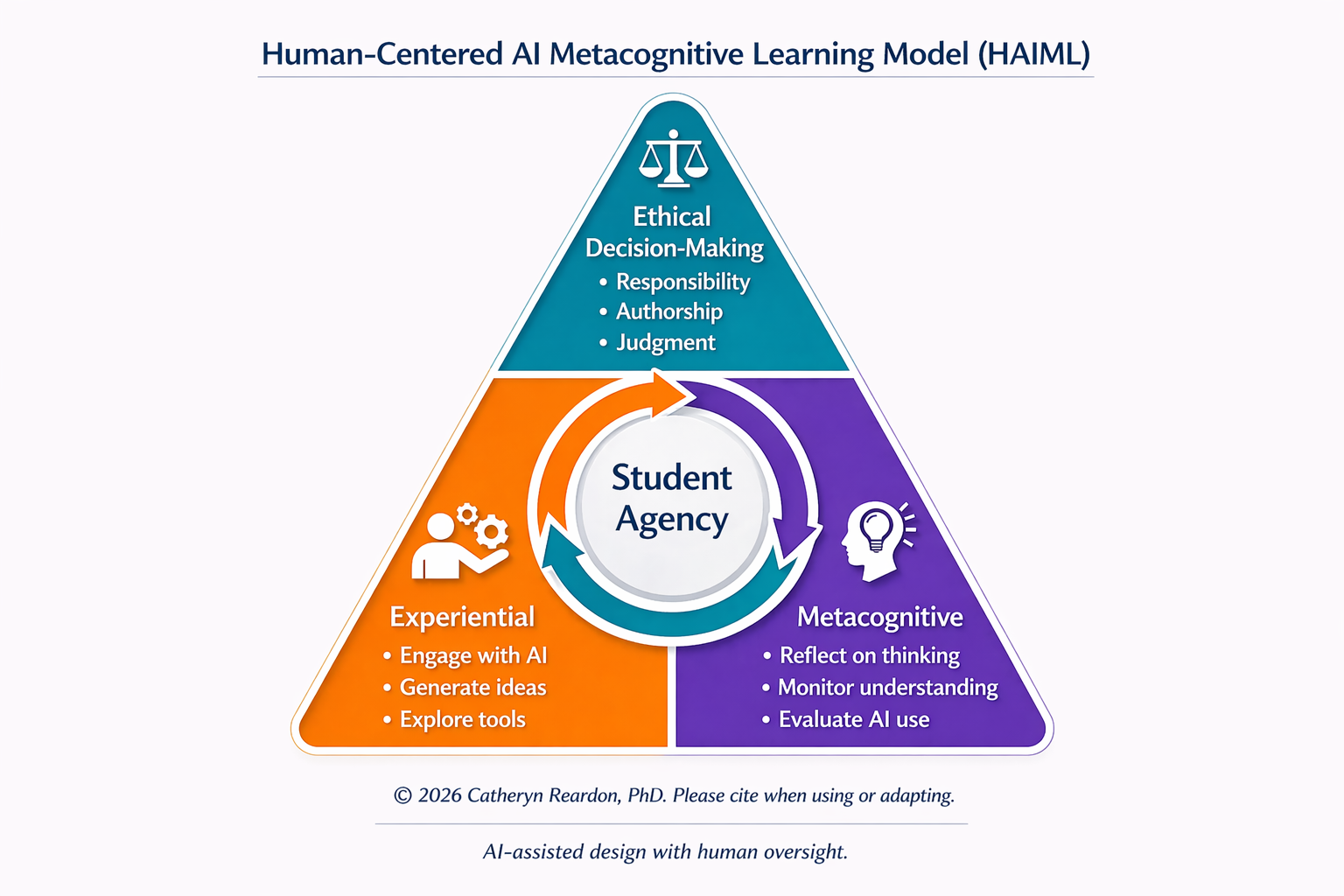
Figure 1.The Human-Centered AI Metacognitive Learning Model (HAIML).
The framework illustrates the relationship between Experiential AI Use,
Metacognitive Reflection, and Ethical Decision-Making. Human agency serves
as the foundation of the model, while reflection functions as the bridge
between AI use and meaningful learning.
Note. Developed by Catheryn Reardon (2026). AI-assisted design with human oversight.
HAIML at a Glance
Human-Centered: Students remain active decision-makers when using AI
Experiential: Learning includes direct engagement with AI tools
Metacognitive: Students reflect on how AI shapes their thinking and learning
Ethical: AI use is evaluated through responsibility, authorship, and judgment
Structured: AI use is guided through intentional design and clear expectations
The Human-Centered AI Metacognitive Learning Model (HAIML), developed by Catheryn Reardon, PhD, is a framework designed to guide how students learn with AI while maintaining human agency, critical thinking, and ethical responsibility. Rather than positioning AI as a replacement for learning, HAIML centers the human learner and asks how AI can support reflection, judgment, and intentional engagement.
HAIML is grounded in the idea that students should not simply use AI to complete tasks. They should also think critically about how AI influences their choices, their confidence, their revision process, and their understanding. In this way, learning with AI becomes both experiential and reflective.
Suggested Citation:
Reardon, C. (2026).
Introducing HAIML: A Human-Centered AI Metacognitive Learning Model:
A Framework for Human Agency and Reflective Learning in the Age of Artificial Intelligence
(Version 1). EdArXiv.
https://doi.org/10.35542/osf.io/qhjgs_v1
HAIML White Paper
The official HAIML white paper expands on the theoretical foundations, metacognitive framework, ethical decision-making structure, and applications of the Human-Centered AI Metacognitive Learning Model.
Reardon, C. (2026).
Introducing HAIML: A Human-Centered AI Metacognitive Learning Model:
A Framework for Human Agency and Reflective Learning in the Age of Artificial Intelligence
(Version 1). EdArXiv.
https://doi.org/10.35542/osf.io/qhjgs_v1
HAIML 2.0 White Paper
HAIML 2.0 expands the original framework to address cognitive resilience,
intentional AI engagement, metacognitive monitoring, calibrated trust,
and ethical and accountable judgment in human–AI decision-making.
HAIML extends established theories of learning, metacognition, and decision-making into the age of artificial intelligence by providing a practical framework for preserving human agency while integrating AI into learning. Rather than treating AI as a replacement for human thinking, HAIML positions AI as a tool that should strengthen reflection, judgment, and ethical decision-making.
Integrates experiential AI use, metacognitive reflection, and ethical decision-making into a unified learning framework.
Extends established theories of self-regulated learning, metacognition, judgment and decision-making, and automation bias to AI-supported learning environments.
Provides educators with a practical framework for designing AI-supported learning experiences that preserve human agency, critical thinking, and reflective learning.
Develops learners' cognitive resilience by strengthening their ability to think critically, adapt to uncertainty, evaluate AI-generated information, and maintain sound judgment while collaborating with AI.
Supports the development of learners who can use AI responsibly while maintaining independent judgment, accountability, and ethical responsibility.
Foundational Theories
HAIML is grounded in established psychological theory and learning science rather than emerging from a single perspective on artificial intelligence. Although AI introduces new opportunities and challenges within education, the underlying questions surrounding learning, motivation, reflection, judgment, and human behavior have been studied for decades. The framework draws from complementary areas of psychology that help explain how individuals learn, regulate their behavior, make decisions, and maintain agency while interacting with increasingly sophisticated technologies.
Human agency serves as a central foundation of HAIML. Drawing on Bandura's work on self-efficacy and social cognitive theory, the framework recognizes that learners are not passive recipients of information but active agents capable of influencing their thoughts, actions, and environments through intentional decision-making and self-reflection (Bandura, 1997, 2001). As AI becomes increasingly integrated into learning environments, maintaining this sense of agency becomes even more important. HAIML encourages students to remain responsible for evaluating information, making decisions, and exercising judgment rather than deferring those responsibilities to technology.
The framework is also informed by research on self-regulated learning. Zimmerman (2002, 2008) demonstrated that effective learners actively plan, monitor, and evaluate their learning processes rather than relying solely on external guidance. HAIML extends these principles into AI-supported environments by encouraging students to make intentional decisions about when, how, and why they use AI. Reflection becomes a mechanism for helping learners remain aware of their goals, monitor their progress, and evaluate the influence of AI on their learning.
Metacognition provides another important foundation for HAIML. Schraw and Dennison (1994) emphasized the importance of awareness and regulation of one's own thinking, while Bjork, Dunlosky, and Kornell (2013) highlighted how learners often develop inaccurate perceptions of their understanding and performance. These insights become particularly relevant when students work with AI systems that can generate convincing responses quickly and fluently. HAIML incorporates structured reflection to help students examine how AI influences their confidence, assumptions, understanding, and decision-making processes.
The framework also draws upon research on judgment and decision-making. Kahneman's (2011) distinction between fast, intuitive thinking and slower, more deliberate reasoning provides a useful lens for understanding how students interact with AI-generated outputs. AI responses may encourage rapid acceptance through automatic processing, reducing opportunities for deeper evaluation and critical thinking. HAIML's reflective activities are designed to interrupt this tendency by encouraging learners to engage in more deliberate analysis before accepting AI-generated information.
In addition, HAIML is informed by naturalistic decision-making research, which examines how people make judgments under conditions of uncertainty, complexity, and incomplete information (Klein, 1998). These conditions increasingly characterize AI-supported environments, where learners must decide what information to trust, what to verify, and how to integrate AI-generated insights into their own thinking. The framework emphasizes that sound judgment remains a fundamentally human responsibility regardless of how sophisticated AI systems become.
Research on automation bias further strengthens the theoretical foundation of HAIML. Parasuraman and Riley (1997) and Cummings (2004) demonstrated that individuals often place excessive trust in automated systems, particularly when those systems appear reliable or authoritative. This tendency can reduce independent reasoning and increase the likelihood of accepting inaccurate recommendations. HAIML directly addresses these risks by embedding reflection, transparency, authorship, and accountability throughout the learning process. Students are encouraged not only to use AI, but also to critically evaluate its outputs and remain responsible for the decisions they make while using it.
Together, these theoretical foundations position HAIML as a human-centered framework for learning in AI-supported environments. The framework integrates research on agency, self-efficacy, self-regulation, metacognition, decision-making, and automation bias to help students remain reflective, ethical, accountable, and actively engaged participants in their own learning. While AI systems may influence thinking and decision-making, HAIML emphasizes that responsibility for learning, judgment, and action remains fundamentally human.
Why HAIML Matters
As AI becomes increasingly embedded in education and professional practice, students need more than access to tools. They need frameworks that help them understand when AI is useful, when it may limit their thinking, and how to remain active decision-makers in the learning process. HAIML provides that structure by connecting use, reflection, and ethics.
This model is especially important in writing-intensive, reasoning-based, and decision-making contexts where students may be tempted to outsource thinking rather than deepen it. HAIML helps shift AI use away from convenience alone and toward the metacognitive and ethical growth that both learning and professional practice require.
Developing Cognitive Resilience
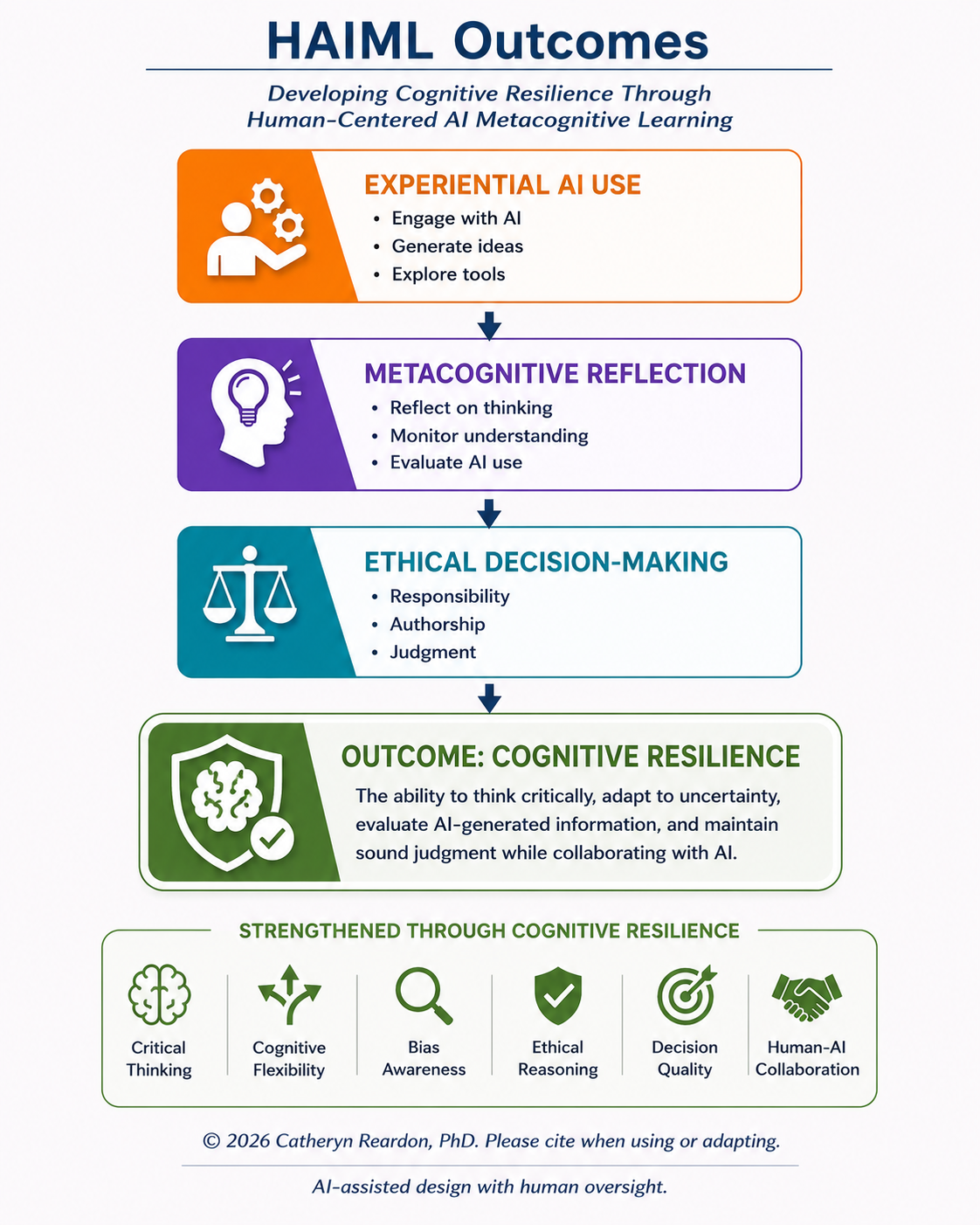
As artificial intelligence becomes increasingly capable, technical AI skills alone are no longer sufficient. Learners must also develop the cognitive resilience to think critically, adapt to uncertainty, evaluate AI-generated information, and maintain sound judgment while working alongside intelligent systems.
HAIML views cognitive resilience as an essential outcome of learning with AI. Rather than encouraging dependence on AI, the framework develops the enduring human capabilities that remain central to effective decision-making, including metacognitive awareness, cognitive flexibility, bias recognition, ethical reasoning, and reflective judgment.
By integrating experiential AI use with structured reflection and ethical decision-making, HAIML helps learners strengthen their ability to collaborate with AI while preserving human agency and accountability. These capabilities prepare students not only for academic success, but also for professional environments where effective human-AI collaboration increasingly depends on resilient thinking rather than automation alone.
Figure 2.Development of Cognitive Resilience Through the Human-Centered AI Metacognitive Learning Model (HAIML).
The figure illustrates how experiential AI use, metacognitive reflection, and ethical decision-making work together to cultivate cognitive resilience.
Note. Developed by Catheryn McClellan Reardon (2026). AI-assisted design with human oversight.
The Three Layers of HAIML
Experiential Layer
In the experiential layer, students actively engage with AI tools in authentic learning tasks. This may include brainstorming, organizing ideas, generating feedback, analyzing responses, or comparing AI-generated material with their own thinking.
Metacognitive Layer
In the metacognitive layer, students reflect on how AI influences their thinking, confidence, judgment, and revision process. They consider what AI helped them see, what it made easier, and where they may have accepted an output too quickly.
Ethical Decision-Making Layer
In the ethical decision-making layer, students evaluate AI use through responsibility, transparency, authorship, fairness, and human accountability.
HAIML and Structured AI Use
HAIML works in close alignment with my four-level AI use guidelines. Together, these models help students understand both what kinds of AI use are allowed and how to think about that use more deeply.
The four-level framework gives students a clear external structure; HAIML develops the internal capacity to navigate that structure with intention.
Applications in Teaching and Learning
HAIML can be applied across online courses, writing-intensive assignments, discussion activities, reflection tasks, and AI-supported feedback environments. Its three-layer structure is flexible enough to inform a single assignment or an entire course arc.
In my own work, HAIML informs course design, structured AI assignments, reflective prompts, AI-supported grading with human oversight, and faculty conversations about responsible AI integration.
Future Directions
HAIML continues to evolve as I study how students experience AI-supported learning and how educators can preserve human judgment in technology-rich environments.
Future work will also address the evolving nature of AI tools themselves. As AI capabilities expand, the frameworks students need to navigate them must expand as well, not by lowering expectations for human judgment, but by raising them.
Bandura, A. (1997). Self-efficacy: The exercise of control. W.H. Freeman.
Bandura, A. (2001). Social cognitive theory: An agentic perspective. Annual Review of Psychology, 52(1), 1–26.
Bjork, R. A., Dunlosky, J., & Kornell, N. (2013). Self-regulated learning: Beliefs, techniques, and illusions. Annual Review of Psychology, 64, 417–444.
Cummings, M. L. (2004). Automation bias in intelligent time critical decision support systems. AIAA 1st Intelligent Systems Technical Conference. https://doi.org/10.2514/6.2004-6313
Kahneman, D. (2011). Thinking, fast and slow. Farrar, Straus and Giroux.
Klein, G. (1998). Sources of power: How people make decisions. MIT Press.
Parasuraman, R., & Riley, V. (1997). Humans and automation: Use, misuse, disuse, abuse. Human Factors, 39(2), 230–253.
Schraw, G., & Dennison, R. S. (1994). Assessing metacognitive awareness. Contemporary Educational Psychology, 19(4), 460–475.
Zimmerman, B. J. (2002). Becoming a self-regulated learner: An overview. Theory Into Practice, 41(2), 64–70.
Zimmerman, B. J. (2008). Investigating self-regulation and motivation: Historical background, methodological developments, and future prospects. American Educational Research Journal, 45(1), 166–183.